Showing posts with label Titanic. Show all posts

Monday, September 30, 2019

Titanic April 1912

‘Stern View, Titanic’ from the famous Father Browne Collection of Titanic images. Taken while the ship is anchored at the entrance to Cork harbour, passengers can be seen relaxing on the after deck. A closer inspection of the after funnel reveals the image of a man’s head taking advantage of the spectacular views from his lofty position above the ship. Three and a half days after this nostalgic image was snapped, many of those passengers would have witnessed great tragedy and many would have been lost in the icy waters of the North Atlantic.
Titanic's captain, Edward John Smith, was born in Well Street in Hanley in 1850. The son of a pottery presser and a grocer, Smith attended Etruria British School before starting work at age 12 at the Etruria Forge, where he operated a steam hammer.
A few years later, he went to Liverpool to follow in the footsteps of his half-brother Joseph, who was in the Merchant Navy, and was apprenticed as an ordinary sailor. By the age of 25 he had passed his master's certificate of competency to command a vessel and by 1880 had joined the White Star Line where he rose through the ranks to captain some of the biggest ships of the day.
He married Sarah Eleanor Pennington, a farmer's daughter, in 1887, and their only child, Helen Melville Smith, was born in 1898.
Smith told a New York Times reporter in 1907 he had "never experienced any problems at sea". That same year, White Star revealed plans to build three new ships - the Olympic, the Titanic and the Gigantic. The Olympic went into service in 1911 and was captained by Smith, who now held the rank of commander.
By this point, he had become known as the "millionaire's captain", the number one choice for the aristocrats of the time - many of whom chose to sail with him because of his reputation for safety and affability.
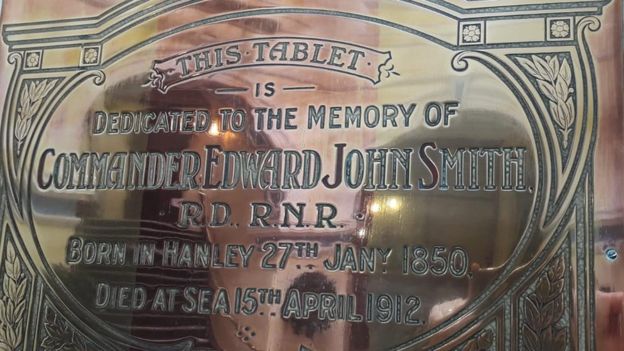
The plaque
Image captionA plaque to Smith was installed at Hanley Town Hall

In April 1912, while the Olympic was in for repairs, he took command of the supposedly "unsinkable" RMS Titanic for its maiden transatlantic voyage from Southampton to New York. When it departed, the ship was carrying 885 crew members and 1,316 passengers.
Smith was awoken about 20 minutes before midnight on 14 April after the ship hit an iceberg.
The liner sank less than three hours later at about 02:20. About 1,500 people perished, including Smith who went down with his ship.
A number of different accounts emerged about what the captain's last movements were, with one version that he dived into the sea as the bridge of the ship went under.
The British inquiry into what happened found that Smith had ordered the ship to travel too fast and that the lifeboats had not been filled before being lowered, but it was made clear that "negligence cannot be said to have had any part".
Smith's portrait was hung in his former school in 1913 and later a plaque was installed in Hanley Town Hall, while a further plaque was installed at his former home in 2012 to mark 100 years since the ship's sinking.
A bronze statue of him stands in Lichfield's Beacon Park in south Staffordshire.
..........................................
Ancestry: The Titanic Collection for Family Historians

Halifax, Nova Scotia, Canada, RMS Titanic Fatality Reports, 1912
Halifax, Nova Scotia, Canada, RMS Titanic Graves, 1912
Titanic Survivors, Carpathia Passenger List, 1912
UK, RMS Titanic, Crew Records, 1912
UK, RMS Titanic, Deaths at Sea, 1912
UK, RMS Titanic, Outward Passenger List, 1912

molegenealogy.blogspot.co.za/2012/04/titanic-records-online.html

Saturday, April 13, 2019

Souvenir Saturday : the Titanic on her way 1912


RMS Titanic departed Southampton on 10 April 1912, colliding with an iceberg during her maiden voyage to New York City.  As one lady reportedly remarked from one of the lifeboats, Now there's a sight you don't see every day.

At least 13 couples chose to celebrate their honeymoon on the Titanic.


Read more revelations about the Titanic at


Thursday, September 20, 2018

Shipwrecks and genealogy research

The other day I was asked why I included shipwreck reports and other sources on these events in my blog. What did they have to do with genealogy? I would have thought this was self-explanatory.

Perhaps if your ancestors had sailed on ships such as the Titanic or the Waratah, for example, entire families - parents and children - were lost in the wrecks. To have so many people from among your ancestry summarily 'taken out' would surely give any family historian pause.

It should also follow that descendants would want to find out as much as possible about the families involved, unearth photos of them, discover their place of origin, read as much context as is available on the ship itself and how it came to disaster. It would be likely to become an obsession for the family historian concerned.

So, I make no apology for including the topic of shipwrecks on these pages and will continue to do so for the benefit of any family historian who is trying to find out more about 'lost' ancestors lying in some unmarked watery grave.


Wednesday, April 12, 2017

Titanic 105 Years Anniversary 15 April 1912


RMS Titanic was a British passenger liner that sank in the North Atlantic Ocean in the early morning of 15 April 1912, after colliding with an iceberg during her maiden voyage from Southampton to New York City.

I asked for ice, but this is ridiculoussaid John Jacob Astor IV, according to legend ...


1. The RMS Titanic was the world’s largest passenger ship when it entered service, measuring 269 metres (882 feet) in length, and the largest man-made moving object on Earth. The largest passenger vessel is now Harmony of the Seas, at 362.12 metres.
2. The ship burned around 600 tonnes of coal a day – hand shovelled into its furnaces by a team of 176 men. Almost 100 tonnes of ash were ejected into the sea every 24 hours.
3. The ship's interiors were loosely inspired by those at the Ritz Hotel in London. Facilities on board included a gym, pool, Turkish bath, a kennel for first class dogs, and a squash court. It even had its own on board newspaper – the Atlantic Daily Bulletin.
4. There were 20,000 bottles of beer on board, 1,500 bottles of wine and 8,000 cigars – all for the use of first-class passengers.
5. The Grand Staircase on board descended down seven of the ship’s 10 decks and featured oak panelling, bronze cherubs and paintings. Replicas can be found at the Titanic Museum  in Branson, Missouri.
6. The staircase at the White Swan Hotel in Alnwick, contains banisters from the Grand Staircase of the Titanic’s sister ship, the Olympic. They are presumed to have been identical.
7. Only 16 wooden lifeboats and four collapsible boats were carried, enough to accommodate 1,178 people. That's only one-third of Titanic's total capacity, but more than legally required.
8. There were 246 injuries and two deaths recorded during the ship’s 26-month construction in Belfast.
9. Twenty horses were required to carry the main anchor.
10. 100,000 people turned up to see the ship’s launch on May 31, 1911.

More at www.telegraph.co.uk/travel/lists/titanic-fascinating-facts/

TITANIC RECORDS ONLINE:
Ancestry's Titanic Collection consists of:

Halifax, Nova Scotia, Canada, RMS Titanic Fatality Reports, 1912
Halifax, Nova Scotia, Canada, RMS Titanic Graves, 1912
Titanic Survivors, Carpathia Passenger List, 1912
UK, RMS Titanic, Crew Records, 1912
UK, RMS Titanic, Deaths at Sea, 1912
UK, RMS Titanic, Outward Passenger List, 1912


Tuesday, April 19, 2016

Titanic Anniversary


The sinking of the RMS Titanic occurred on the night of 14 April through to the morning of 15 April 1912 in the north Atlantic Ocean, four days into the ship's maiden voyage from Southampton to New York City.


Ancestry: The Titanic Collection for Family Historians

Halifax, Nova Scotia, Canada, RMS Titanic Fatality Reports, 1912
Halifax, Nova Scotia, Canada, RMS Titanic Graves, 1912
Titanic Survivors, Carpathia Passenger List, 1912
UK, RMS Titanic, Crew Records, 1912
UK, RMS Titanic, Deaths at Sea, 1912
UK, RMS Titanic, Outward Passenger List, 1912

http://molegenealogy.blogspot.co.za/2012/04/titanic-records-online.html

Monday, February 8, 2016

Shipwreck survivors and other arrivals 15


If your ancestor was part of a crew on board ship arriving at a South African port in the 19th c there is little chance of finding him mentioned in shipping registers. In the 20th c, with the large liners making regular calls in South Africa, records were kept of crew members usually at the port of embarkation. The crew list of Waratah, for example, is available. All of the latter went down with the ship.

Crew of Waratah


I have sometimes received queries from family historians who say their ancestor 'jumped ship' in South Africa. This wouldn't be a good place to start a search. Better to go to NAAIRS and see if there is a deceased estate file held for him at archives. If the man was divorced or was involved in a court case of any kind during his sojourn in South Africa there may well be evidence of that among the references. It helps if the ancestor had an unusual name: Joe Smith would bring up an avalanche of hits.

If the ancestor travelled to South Africa by ship but for some reason leapt overboard and was lost at sea, the only hope is the Deaths at Sea records.
molegenealogy.blogspot.co.za/2010/02/births-deaths-and-marriages-at-sea-uk.html
These include names of passengers and crew of the Titanic and Lusitania, incidentally.

Records at sea are online at www.bmdregisters.co.uk/  
These  cover over 150, 000 individuals (previously only searchable on microfilm) who were born, married or died on ships between 1854-1908. They are definitely not all-inclusive.


Union Castle Ship crew


Friday, February 5, 2016

Shipwreck survivors 14: Titanic, Waratah, American

In more recent times, if an ancestor was shipwrecked on a large liner there is a good chance that the event was well-documented, even that a passenger list was published in the press. I am thinking of the obvious famous vessels like Titanic and Lusitania, though there are less publicised wrecks such as that of the American in the1880s. The survivors of the latter ship had to undergo a second shipwreck immediately after the first, on the ship which was supposedly taking them to safety. Not a good day for those on board.
molegenealogy.blogspot.co.za/2010/05/shipwreck-reports-for-family-history.html


The Waratah, which mysteriously disappeared off the South African coast in 1909, was the topic of numerous  reports in local and international press for many months and the list of her passengers was published several times. Despite these facts being to hand, there are frequent claims made by alleged descendants that their ancestor was among those on board the fated ship.


It is evidence of a strange desire to be associated in some way with a famous and tragic incident - rather like descendants who hold to it, buckle and thong, that their forebear fought at Rorke's Drift in 1879 when it is perfectly clear from documentary evidence that he was not among that small courageous band of British soldiers. 

What particular claim to fame it might be for an ancestor to have been lost on the Titanic or the Waratah remains nebulous, but there's no doubt that a certain glamour attaches to such an ancestor.

I sometimes receive queries from family historians who ask why shipwrecks are relevant to the topic of genealogy. Clearly the loss of an individual in a wreck certainly was relevant to his or her family and undoubtedly changed the course of the latters' lives. Also, the mere fact of an ancestor dying in this manner means that information will be available - on the more well-known vessels at least. All grist to the family historian's mill. 

On rare occasions details may emerge about an ancestor wrecked on a little-known vessel. An example was finding mention of Sturges Bourne Bell, son of Captain William Bell, who was shipwrecked off a collier near the coast of Spain in 1873. This reference led to the discovery of further information on this obscure and elusive forebear.
molegenealogy.blogspot.co.za/2014/01/the-shipwrecked-mariner-and-spanish.html


Sunday, April 15, 2012

Titanic records online

10 April 1912
RMS Titanic the White Star Liner with Captain Edward J. Smith in command, steams into the English Channel on her maiden voyage from Southampton, England, bound for New York City.

12 April 1912
Titanic steams westward on a calm and sunny sea but around sunset a wireless message comes through from the French Liner, La Touraine, with warnings of ice ahead.

13 April 1912
Late into the night of the 13th April Titanic and the Rappahannock pass each other within signalling distance, the Titanic is warned of the ice danger ahead.

14 April 1912
The wireless crackles with fresh warnings reporting bergs, growlers and field ice in 42 degrees N from 49 degrees to 51 degrees W, throughout the day further warnings continue to be received and at 1.42 p.m. the White Start Liner Baltic reports icebergs and large quantity of field ice in 41 degrees 51'N, 49 degrees 9'W about 250 miles ahead.

Further messages come through and finally at 9.40 p.m. the Atlantic Transport Liner Mesaba reports at Latitude 42 degrees N to 41 degrees 25'N, Longitude 40 degrees to 50 degrees 30'W heavy pack ice, large icebergs and field ice.

Titanic is already within the rectangle marked out by this warning. All six messages put together indicate an enormous belt of ice stretching 78 miles across Titanic's path, but the six messages are not consolidated due to a lack of communication, and to complacency.

And on a starlight but moonless night in calm weather and calm waters, just before midnight Titanic collides with a 15,000 year old iceberg, ninety percent of which is below the water level, with no wave action around the base offering a possible early warning.

15 April 1912
Titanic carrying 20 lifeboats - only enough for about half the passengers and crew - sinks at 2.20am.


NEWS FOR FAMILY HISTORIANS

Ancestry have recently added The Titanic Collection consisting of:

Halifax, Nova Scotia, Canada, RMS Titanic Fatality Reports, 1912
Halifax, Nova Scotia, Canada, RMS Titanic Graves, 1912
Titanic Survivors, Carpathia Passenger List, 1912
UK, RMS Titanic, Crew Records, 1912
UK, RMS Titanic, Deaths at Sea, 1912
UK, RMS Titanic, Outward Passenger List, 1912

Saturday, February 27, 2010

Births, Deaths and Marriages at Sea: UK sources


From 1854, registers were compiled from ships’ official logbooks of births, marriages and deaths of passengers at sea. All these were recorded from 1854 to 1883, births and deaths only from 1883 to 1887 and deaths only from 1888 onwards. They are held at The National Archives (TNA), Kew in Registers of Births, Marriages and Deaths of Passengers at Sea (BT 158).

Masters (captains) of vessels were required from 1874 to report births and deaths at sea to the Registrar General of Shipping and Seamen and these records are at TNA. Registers of Births of British Nationals at Sea are in BT 160 and Registers of Deaths of British Nationals at Sea in BT 159.

For the period 1891 to 1964, BT 334 at TNA contains Registers and Index of Births, Deaths and Marriages at Sea. These include death registers of the passengers and crew of the Titanic and Lusitania.

The location of a death at sea may be given in latitude and longitude. Other details offered in these records include name, occupation, age or date of birth, address, date and cause of death, and port of registry of the ship.

Passports
I’m often asked about passports as a possible source of information. Before World War I there was no requirement for travellers to obtain a passport when leaving Britain and few emigrants bothered to apply for one. Foreign Office Passport Registers (TNA in FO 610) are indexed by name, giving date of issue and serial number of each passport between 1851 and 1862, and 1874 and 1898. There are registers in chronological order going back to 1795. Passports as we know them didn’t come into being until 1921.

Update:

TNA, Kew, has now (March 2010) released records at sea online at http://www.bmdregisters.co.uk/
The records cover over 150, 000 individuals (previously only searchable on microfilm) who were born, married or died on ships between 1854-1908.

Also see on this blog: http://molegenealogy.blogspot.com/2012/10/births-deaths-and-marriages-at-sea.html
How to find UK Maritime BMD on FamilySearch.org partnered by findmypast.com