Tuesday, June 12, 2012

Passenger Arrivals and Departures: Natal 1863

Report of the departure of RMS Dane 'for Capetown and Intermediate ports', in the Natal Mercury of 3 July 1863, illustrates that troops on board were generally not named in published shipping lists. Officers occasionally were but here 2 non-commissioned officers (NCOs) and six soldiers, travelling Third Class, pass unidentified into history.

The port is very busy, with several vessels of heavy draught (for that era) waiting Outside, others which have already entered, and a number still 'expected'. This last is a useful feature when tracking an ancestor on a particular ship - for example, the column announces that the Maritzburg sailed from the Downs 1st March, so obviously a search forward for its arrival would be indicated.

The Dane, built in 1855, pioneered the Union Company's service to the Cape in 1857, inaugurating the mail service to that port. During her interesting career, she was later (1865) chartered by the Admiralty to convey stores to Zanzibar for the British naval forces engaged in the suppression of the slave trade on the east coast of Africa. Having left Simonstown on 28 November 1865 on her way to play this important role, she was stranded during her approach to Port Elizabeth and became a total wreck. Passengers and crew were safely taken off.

Sunday, June 10, 2012

Passengers and immigration: Natal 1860s

An extract from the 'Shipping Intelligence' column, Natal Mercury of 9 June, 1863, emphasises the variety of vessels calling at Durban in the early years of that decade: from the single-masted but grandiosely-named cutter of only 43 tons - the Albert Edward, Prince of Wales - to the Hamburg barque Cuba, 400 tons. Some regular visitors in port include the barque Durban, the Natal Star (later wrecked) and the Lady of the Lake.

The arrival of the barque Symmetry from Glasgow is a reminder that ships carrying a general cargo frequently carried a few passengers - in this case, two, who are named.

The Evangeline had sailed for London, carrying among other passengers the Rev W H C Lloyd (the Colonial Chaplain) and his wife and a Captain Lamb of the Royal Navy. Were the Gowenlock brothers (travelling steerage) leaving the Colony for Home after a disappointing attempt at settling? The 1860s was not a boom period for South Africa and numbers of would-be colonists left, returning to their place of origin or looking for greener pastures elsewhere. In 1866 a Natal pioneer wrote to his family in England:
Every ship that is leaving is full of people going Home again, and it seems that everyone that can just get money enough to get Home is clearing out as fast as they can. I am sorry to see it, as it will put the Colony back years.
A family historian tends to consider that once the ancestors made the huge decision to emigrate, they duly did so, and stayed in the new country of choice. Many of them did, of course, but despite the dangers and discomforts of long sea voyages settlers frequently explored opportunities in other colonies. In the early 1850s, for example, the Australian goldfields proved a lure for South African settlers. Conversely, disenchanted Australian colonists later responded to the call of the South African diamond fields.

After the excitement of the Byrne and other organised private schemes had died down, Natal sank into a state approaching apathy as far as immigration was concerned. The years between 1857 and 1862 produced less than 1 500 new settler arrivals.

Saturday, June 9, 2012

Natal Passenger Lists 1861

This is a shipping column from the Natal Mercury 13 July 1861.  Though at first glance it doesn't appear particularly exciting, some interesting points emerge on closer inspection of the details.

No passengers are listed for several of the vessels described as 'Arrived' (at Durban). The 384 ton barque Randolph, from London, was still 'Outside' i.e. waiting in the roadstead beyond the entrance to the port. Nevertheless, her passengers are named - in one instance not felicitously: Alex 'Climmury' was actually Alex Cumming.

It's the sort of error that creeps into newspaper passenger lists - these might have been transcribed three times (the captain's or agent's list, the port captain's list and the newspaper shipping reporter's transcript) before publication, making a good case for comparing a published list with the relevant hand-written original register: Cumming is clearly the correct version.

On the other hand, the printed list was helpful in my search for another passenger on the Randolph - Thomas Thomas (a name to conjure with at the best of times) is given simply as 'Thomas' (his surname) in the original register. The addition of his forename in the news column enabled confirmation of his identity. So, again, using both sources paid off.

For those who like contextual detail, the 'Goods Entered Inwards' paragraph shows the cargo carried by the Randolph: it includes various hogsheads and casks (contents not divulged), anvils, rope, nails, chain, grindstones, planks, a large quantity of creosoted timber, an iron boat, a wooden boat with sail and oars, rudders, anchors, axes, bellows, 2 monkeys, a pig house plus 1 pig, and 2 dogs - with kennels.


Thursday, June 7, 2012

Passengers to Natal, 1862


Arrival of Catherine 8 March 1862

Port Captain's list of Government Emigrants per Ship CATHERINE, Captain R PATTIE, 493 tons, departed London Nov 5, Portland Dec 3. 48 emigrant. Departed Natal May 25 bound for Akyab, Burma.

Cabin passengers:
Mr and Mrs Eridge
Passengers:
Fox, John
Cooper, Mark
Hind, John
Hind, Sarah
Hind, Mary
Hind, James
Hind, C. Larison
Hind, John
Hind, Charlotte
Hind, William
Hind, Arthur
Bouham, Thomas
Bouham, Emma
Bouham, Tom
Bouham, Mary
Bouham, John
Bouham, infant
Huggins,Thomas
Huggins, George
Huggins, Ellen
Jones, Richard
Magnus, John
Magnus, Sarah
Magnus, Sarah
Magnus, George
Magnus, Elizabeth
Magnus, Harriet
Milton, William
Philliplis/Phillips, Arthur
Walker, William
Walker, Elizabeth
Walker, Helen
Walker, Mary Ann
Northern, William
Northern, Emma
White, Jamey/Janey
White, Mary Ann
Seymour, Cayo
Seymour, Mary Ann
Seymour, John
Seymour, Charles
Seymour, Eliza
Seymour, Vincent
Seymour, Henry
Seymour, Arthur
Stanley, Fred
Black, William
Black, Jane
Fox, Edmund


Wednesday, June 6, 2012

Passengers to Natal: 1865

Newspaper shipping columns can be unusually informative: this one, from the Natal Mercury of 25 April 1865, shows the arrival of R.M.S. Anglian at Natal. Names of First and Second Class passengers (regrettably omitting most initials) are given, including those who were continuing onward to Mauritius.

There's also a brief account of the voyage from Table Bay, arrival and departure times at the intermediate ports and comments on wind and weather. Interesting details to add to a family narrative.

The Anglian mentioned in this report was a coaster which had been built especially for the conveyance of mails between Natal and the Cape, a contract awarded to the Union Line in 1865. She was of a light draught so that whatever the tide she could cross the bar at the entrance channel to Durban's harbour. Also employed on the Mauritius run, she left the Union fleet in 1869 when she was bought by a Dublin company and her name changed to City of Lisbon. She sank in November 1903 after a collision during a voyage from Malaga to Liverpool; salvage being impossible, the remains of the wreck were blown up.

This Anglian is not to be confused with the later ship of the same name built in 1873, which made her maiden voyage with Barney Barnato on board, then an obscure passenger but later to emerge as one of the most successful of those who made their fortunes in the South African diamond fields.

Transit of Venus


Today South Africans will be able to witness a celestial spectacle no one will ever see again this century: a transit of Venus. While Venus starts to slowly pass between Earth and Sun, millions of people will look in awe at the planet’s silhouette against the brilliant solar disk, beholding the actual clockwork movement of our solar system. It’s one of the most infrequent of planetary alignments, and its rarity alone should justify your own observation of the transit. If you miss this one, you will have to wait another 105 years - until  December 2117. The last transit took place in 2004.

Because of its rarity, viewing the transit yourself not only connects you to the hundreds of astronomers in history who set out on perilous journeys to measure the Sun’s distance using the transit of Venus, but also to your descendants who will see it again in the next century: it will make you part of a chain of privileged people to whom Venus reveals her black profile backdropped by the solar disk ...

Continue reading: http://transitofvenus.nl/wp/2012/06/04/this-centurys-last-transit/

Sunday, June 3, 2012

Natal Contingent to London for Queen Victoria's Diamond Jubilee

http://gmic.co.uk/index.php/topic/52720-1897-golden-jubilee-medal-to-a-colonial-soldier/


Included on the above forum page is a list of the men who represented Natal at Queen Victoria's Diamond Jubilee celebrations in London, with a sketch of the Natal Cavalry contingent in the Jubilee procession.  The sketch is from an 'Illustrated Programme of the Royal Jubilee Procession'.

[Brett Hendey's posts, Gentleman's Military Interest Club forum, January 2012.]


Another Queen Another Jubilee: 1897

From the Daily Telegraph's Centenary Supplement 

Saturday, June 2, 2012

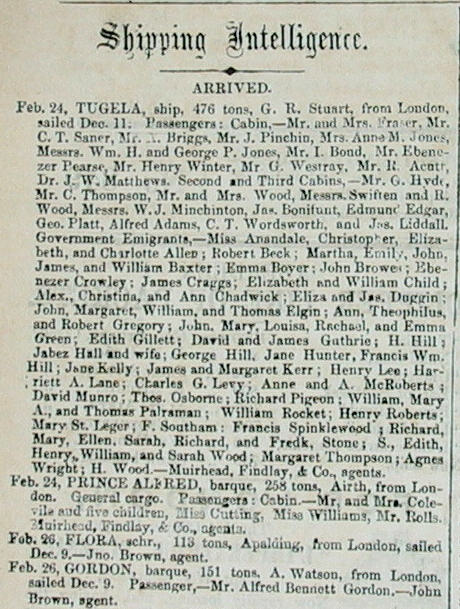
A typical shipping column: Natal 1865

A typical shipping column from the Natal Mercury showing the arrival at Port Natal of the ship Tugela, 24 February 1865 (sailed from London 11 December 1864). In this instance the names of the 'Government Emigrants' are included i.e. the steerage passengers.

There are some errors in the spelling of surnames: e.g. Palraman should be Palframan.

The Natal Mercury also offers a report of the voyage and subsequent landing of these settlers, a story which could be applied to many similar experiences at this port:

'The Tugela ... arrived early on Saturday morning, after a voyage from England very much protracted by foul winds in the channel, and off this coast. She was within 250 miles of Natal twelve days before her arrival, but had to share the fate of many vessels that have been waiting for a change of wind. She brings an addition to our population of more than a hundred souls. The passengers' names appear in our shipping intelligence. Eighty of them came out under Government auspices. The whole were landed on Saturday afternoon and they seem a happy and very respectable party of settlers. There was a lamentable scene of uncertainty, bordering on confusion, at the Point, when our new friends came ashore, owing to the utter inefficiency of the present no-system policy pursued by the Government. No one to receive them, no one to direct their movements, to tell that what to do or where to go, no aid, sympathy, nor help of any sort whatever. Lamentable, most lamentable, is this total want of anything like arrangement for the proper reception of European immigrants. The scene on the quay was amusing as usual ... The voyage out, barring the  unavoidable delays that have been experienced, has been pleasant. A newspaper - the Tugela Gazette - was got up on board, and it is to be perpetuated in a printed form. The greater proportion of the passengers seem bound for Maritzburg and the midlands ... A warm welcome to them all. The Tugela was towed inside on Sunday afternoon.'

There follows a copy of the 'testimonial' addressed to the Tugela's Captain, George Stuart, from the passengers thanking him for the excellent way in which he carried out his duties on the voyage and expressing their hope that 'should we again have to commit ourselves to the perils of the deep, we may have the good fortune to meet with so good a ship and so excellent a commander'. Another note of thanks is addressed to the ship's surgeon. These complimentary letters were a feature at that time. Later, with ever-increasing numbers of sailings, the personal touch was lost - as well as a useful source of information for descendants.

Friday, June 1, 2012

Emigration to the Colony of Natal in the 1860s


Colony of Natal: Emigration and Land Grants Under Government Authority.

Entrance to the Bay of Natal, Bluff on the right, Point on the left,
with a sailing ship arriving.
The Colony of Natal is situate on the south-east coast of Africa, looking into the Indian Ocean, 800 miles beyond the Cape of Good Hope, and 6 900 miles from England.

It is in the 30º south latitude, and has its winter in July, and its midsummer in December. The winter is nearly as warm as an English summer in the middle of the day, but it has cool nights. The mean temperature of the year is from 64½ to 68º. Thirty inches of rain fall during the year, principally in the summer season. The winter is bright, dry and sunny. The elevation of the land varies from the sea level to 6 000 feet.

The Colony is about one-third the size of England; it contains 17 000 square miles and has a population of 17 000 Europeans and 170 000 native Africans. It possesses a fertile soil and a beautiful and healthy climate, and has an abundance of good pasture land.

Sugar, coffee, and arrowroot are grown in the coast districts, where the orange, pine-apple and banana ripen abundantly in the gardens. The hill-districts furnish good dairy-farms and grazing-grounds and grow wheat, oats, barley and other corn and root crops such as potatoes, beet and turnips. Indian corn grows everywhere; and tobacco in most places. Cattle, horses and sheep thrive in the uplands. The Colony has only been occupied by the English since the year 1842. But there are, nevertheless, now 300 000 cattle, 20 000 sheep and 17 000 horses on the pastures and about 6 000 tons of sugar are exported in the year.

The Colony affords an excellent field for the enterprise of practical agriculturists, who have a little means to start with, and who have a family to settle. But no one should go to it unless he has enough money to provide for himself until he can bring his land into cultivation and yielding, and unless he knows how to till the ground and manage stock and the dairy. The Colonial Government furnishes assistance and countenance to men of this class; but discountenances all other kinds of immigrants. Just now the Colony has as many artizans and handicraftsmen as it requires; and clerks, shop-men and persons trained to the learned professions, cannot find remunerative employment.

To men who have the requisite knowledge and skill, who pay their own passages, and who possess a capital of ₤500, or a sufficient yearly income, the Colonial Government gives a free grant of 200 acres of selected land, with a reserve of 200 other acres adjoining, which may be bought for 10s an acre, at the end of five years. Actual occupation for four years is required before the land is finally transferred in freehold.

Pastoral runs of one thousand acres in extent may be hired from the Government on eight years’ lease, at a rental of one penny per acre per annum, under the condition of actual occupation and stocking, the Government reserving to itself the right to terminate the occupation of any portion of the runs, by giving 60 days’ notice at the end of any one year, and allowing a fair sum for permanent improvements. These runs are purchaseable by the occupier at any time in the open market.

A limited number of approved men of smaller means, who know how to turn the land to account, and who can provide for themselves and their families until the land yields them sustenance, are sent out with assisted passages under arrangements that have to be considered and settled beforehand. The settlers get free grants of 50 acres of good land, with right to surrounding commonage, receive passages by Government ships on payment of ₤6 per statute adult to the Government Emigration Board, 8 Park Street, Westminster, in London, and are assisted at the lowest possible charge to themselves to get conveyed to and settled upon their grants.

The charges of first-class passages by sailing ships is 35 guineas for each adult but passages may occasionally be had for less, under special arrangements.*  The payments for these have to be made to the owners of the vessels, or to their agents, and not to the Government. The voyage averages about 65 days by sailing ship. It is made in 40 days by the mail steamers.

For further information application may be made to the special Immigration Agent of the Colonial Government, Dr Mann, at the Natal Immigration Office, 15 Buckingham Street, Strand, London.
July 1867.

Extract from Natal Almanac & Yearly Directory 1867.

* The cost of a steerage passage from British ports to Natal was from ₤12 to ₤15. An ‘intermediate’ passage could be obtained for between ₤20 and ₤31. Cabin passengers could pay between ₤30 and ₤50 depending on port of departure (London, Liverpool, Plymouth, Southampton or the Clyde ports).