Showing posts with label indentured Indians. Show all posts

Thursday, January 21, 2016

Shipwreck survivors 6: the Fusilier wreck

Not all wrecks in the vicinity of Port Natal escaped loss of lives on  board.

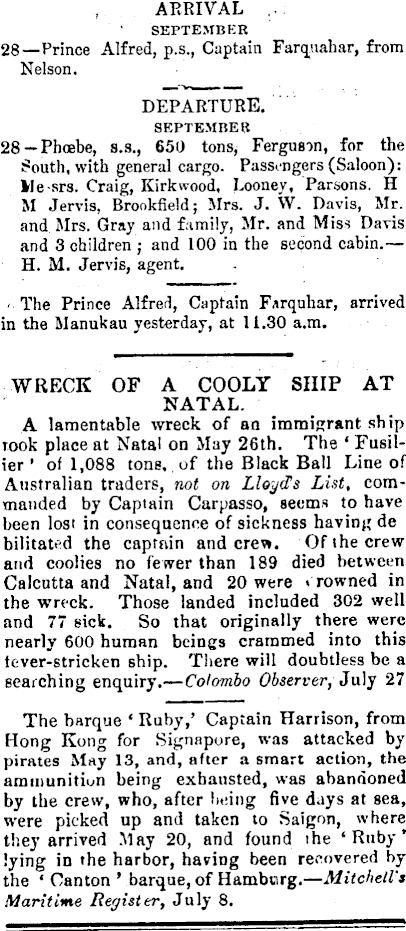
The Newcastle Guardian and Tyne Mercury reported on Saturday 22 July: 

Received on Monday from Natal it appears that the ship (Fusilier), while lying off that harbour on the 25th of last May in gale of wind, broke from her anchors, and was totally lost on the Bluff Rocks at the south side of the entrance of Natal, and 26 of her passengers were drowned.

The ship had previously lost 189 passengers during the voyage, due to fever. More detail is to be gleaned from the Australian press on this incident, under the heading Wreck of a Cooly ship at Natal. This is a reminder that from 1860 indentured labour began to be brought to the Colony primarily to work on the sugar fields. The report gives an indication of how these immigrant ships were crammed to bursting point.


Indentured Indians arriving at Natal


Note: coolie or cooly was not at that time considered an opprobrious term


Friday, March 8, 2013

The Noon Family in Natal: Mormonism and Sugar


In the Natal Mercury of March 20 1863 there appeared the following paragraph:


Adolphus Henry NOON (the Mormon Elder mentioned in the above extract) and his brother Arthur N. NOON were sugar planters on the Isipingo River from about 1860 to 1863. Their sisters were Clara Jane and Susan Noon. Clara is better known as the wife of Richard ('Dick') King, also of Isipingo, the Natal colonist who undertook the famous ride to Grahamstown in 1842, taking news of the besieged British Garrison at the Port and enabling reinforcements to be sent by HMS Southampton and William BELL's schooner Conch, which ended the siege. The younger Noon sister, Susan, married another famous Natalian, Robert Bristow TATHAM. A brother to the Noon siblings, Charles, died in England in infancy; Kent was their home county, and all were born and baptized there.

In April 1863, a month after the above Natal Mercury reference, Messrs A H and A N NOON offered for sale their 300 acre sugar estate on the Isipingo plus various items of related equipment including 1 by 12 h.p. (i.e. horse power) steam engine, 1 by 6 h.p. steam engine, 1 new boiler 25 ft by 5 ft, 1 Bour Wetzel, 5-pan battery and 4 clarifiers. (See 'Valiant Harvest' p 284)

A sketch entitled 'A.H. and A.N. Noons' Sugar Mill, Isipingo South Africa 1863' shows the mill building as it looked when the brothers sold their Isipingo Estate. It gives a delightful glimpse into the Natal sugar industry at the time, with small turbaned figures of the indentured Indian workers in the foreground, some returning from the fields with hoes on their shoulders, others loading bags of sugar into a wagon. (The first indentured labourers had arrived in Natal in 1860.) Could the figure on horseback in the central foreground be one of the Noon brothers - or perhaps merely their overseer? To the right of the picture is a separate figure in a turban, carrying a stick, probably an Indian sirdar in charge of the labour. A dog runs at his heels. The words 'Isipingo Estate' can be seen written faintly on the main gable of the mill.*


In January, 1863, Elder Henry Aldus Dixon in company with Brother Aldophous (sic) H. Noon, commenced Latter Day Saints missionary work in Natal. They held meetings at Isipingo (Brother Noon's residence), inviting surrounding sugar planters and others to attend. After a few meetings, the congregation grew into a mob which disturbed and tried to break up the meetings. The magistrate and policemen were on the side of the rowdies, protecting them and screening them while trampling the law under their feet. (Source: A History of the South African Mission, Period I, 1852-1903, by Evan P. Wright).

The Noon brothers departed for the United States with a company of emigrants from Port Elizabeth in April of 1865 aboard the Mexicana, settling in Utah and later in Arizona. It was in 1865 that the South African Mission of the Church of Latter Day Saints was closed, possibly why the Noons left Natal in that year.

'No official reasons were given by Church Authorities in Salt Lake City or in England (headquarters of European Mission) for closing the South African Mission in 1865. Perhaps the chief reasons were because of the indifference of the local people, difficulties encountered by the missionaries, and because most of the faithful members had immigrated to Zion. No doubt Satan and his followers rejoiced when the mission was closed, but their victory was only temporary. LDS missionaries were to return to South Africa in 1903 and thereby fulfil the prophesy made by Jesse Haven on May 23, 1853'. (Evan P Wright Part II 1903-1904)

According to Noon descendants, Adolphus was not involved with the Latter Day Saints prior to his arrival in SA. He was quite young when he joined the British army in England (a South African unit which he knew would send him there - he wanted to join Clara in Natal) but just where and under what circumstances he was first associated with Mormonism is unknown. He was a devout journal keeper and produced three, A, B and C. Journal A was the oldest and was heavy with his experiences in South Africa - mainly his Mormon connections. Unfortunately, after he became disillusioned with the movement (in Utah), journal A disappeared; he probably destroyed it. Journals B and C have survived.

Clara Jane Noon remained in Natal and after the death of her husband Dick King, she married a Durban merchant, Joseph Henry RUSSELL.

*The original drawing of the mill, featured on this page, is in the Old Court House Museum collection, Durban, presented by Mr and Mrs A H Noon. 

Acknowledgements to Tom Montgomery, husband of Adolphus Noon's great great granddaughter, for information on the Noon family.
Also to Jenny Harries of LDS Family History Library for extracts from the works of Evan P Wright.


Thursday, July 12, 2012

Migrants, Passengers and Others


As mentioned at the start of this series of posts on indentured Indian migrants in Natal, for a family historian to make progress towards a clearer picture of the ancestors’ lives is not a simple matter.

However, a good rule in any ancestry research is to think laterally, especially if you have limited basic information. Instead of attempting to pinpoint your migrant directly by unsuccessfully combing the Migrants Index, try beginning with the current generation, yourself and other living relatives, then the previous generation and gradually working back. It’s surprising how many clues such as an Indentured Number or a marriage record can be collected along the way which could lead to a correct identification of the migrant. Deceased estate files of any of the migrant’s direct descendants can provide useful detail; search for these on NAAIRS. You may have to be imaginative in your search terms if there is more than one possible name for the family members (a family name, a ‘house’ name, a nickname, even an alias).

Grey Street taken from Queen St towards the Bay ca 1900; Grey St
mosque at right.
At present, for descendants researching so-called Passenger Indians, there is no database comparable to the Migrants Index. This is understandable. In any immigrant situation where people are entering a country of their own free will having paid for their own passage rather than being part of an organized immigration scheme it is more difficult to trace their movements. Passenger Indians could travel easily to Natal from British India; they began to do so in the mid-1870s, increasingly from the 80’s. For this category of immigrant, family records and memorabilia play a key role. A useful source is the South African Indian Who’s Who. See http://scnc.ukzn.ac.za/

Masulah boat 
Certain Indian immigrants, e.g. haphazard arrivals from Mauritius, naturally do not appear on the Migrants Index. Other groups are more obscure. In 1861, Port Captain Bell, having visited India in his ocean-sailing days, brought experienced oarsmen from Madras to man Masulah surfboats at Natal. Their task: to ferry cargo and passengers from ships anchored in the roadstead. The Natal Almanac & Yearly Directory continues to record through the 1870s the presence of these Masulah* boatmen at Durban, some of whom later settled in Natal as fishermen.

*Madras had a harbour problem similar to Durban's:
'...vessels of heavy burthen are obliged to moor in the roads - about two miles from the fort. A strong current runs along the coast, and a tremendous surf breaks on the shore, rendering it difficult to land even in the calmest weather. In crossing this surf the natives use boats of a peculiar construction, built of very thin planks laced together, and made as pliable as possible. The boats from the vessels often row to the outside of the surf, and wait for the masulah boats to take the passengers on shore.' 
http://www.worthpoint.com/worthopedia/india-madras-chennai-fort-saint-112960023


Other useful links:

An Outline of Indian South African History 1860-1960
http://www.muthalnaidoo.co.za/index.php?option=com_content&task=view&id=111&Itemid=96


Wednesday, July 11, 2012

Searching for migrant ancestors


If while searching the Migrants Index you find a likely contender for your ancestor (from name, date of arrival, estimated age at the time of arrival, father’s name etc) it’s worth looking at the registration numbers immediately adjacent to the number you have located. These could indicate a family unit – parents and children travelling together. For example, in the case of a girl named Rajamma, thought by descendants to be aged under ten at the time of her journey to Natal, an entry on the Index for a girl of eight years old seemed a very possible match. Above her name are those of an adult couple, in all likelihood her parents. Below her name are two young boys, almost certainly her siblings. (Whole families were indentured, not only the male head of the family.)

The final column on the Index tells us that the parents later returned to India, as did the male siblings. There’s no such return recorded for Rajamma who presumably married and remained in Natal. If she is the correct Rajamma - and the chances are good - her descendants have suddenly acquired several previously unknown migrant relatives as well as, no doubt, living relatives in India.

I mentioned caste in an earlier post. This is a vast topic and I will leave it to the specialists such as Prof. Surendra Bhana. For a useful list of castes, with their relevant meanings and professions see http://scnc.ukzn.ac.za/doc/SHIP/caste.html
Names of castes – like the geographical areas of India – have undergone changes since the 1860s.

On board ship ‘there was little official space for caste or custom. A Pariah’s reply to a Brahmin upset at being bumped into, I have taken off my caste and left it with the Port Officer. I won’t put it on again till I come back, poignantly sums up the situation. … Yet it would be wrong to speak of a complete breakdown of the caste system during the voyage. Consciousness of caste and other boundaries would persist long after the voyage and indenture ended.’

[From Chapter 2, Inside Indenture: Ashwin Desai and Goolam Vahed]


Tuesday, July 10, 2012

Tracing your migrant ancestor in Natal


The Migrants Index presents a picture of a fleeting moment. One of the dedicated volunteers involved in the compilation of the Index remarked that ‘we only get one chance with the migrants, that is, on arrival’. After they were dispersed to their various employers it becomes more difficult to follow their trail. The employer to whom a migrant was initially indentured might well not be the employer for the entire period of his indenture. Migrants could be transferred to another sugar estate, for example, even unofficially swapped between employers. Reasons for such arbitrary behaviour varied.

The migrant may remain invisible for much of his sojourn in Natal unless a particular event concerning him generated a public record at the time – that is, a document or file preserved as archival material. These could range from a claim of ill-treatment of a migrant by his employer to an application by a ‘free’ Indian (one who had completed his term of indenture) for a firearm licence. The latter subject provides a fruitful source for discussion about Vijay Maharaj’s ancestors in his book Injustice published in 2007. (ISBN: 1-4196-7877-9 ISBN-13: 9781419678776

Search NAAIRS at www.national.archives.gov.za/ for such references. Again, the difficulty is identifying the migrant by name. If an Indentured or Registration Number is known that can be helpful. A so-called Colonial Number was issued to colonial-born individuals and should not be confused with the Registration or Indentured Number allocated to migrants on arriving in Natal.

Archives of the Indian Immigration Department (1858 - 1924) offer rich pickings for descendants of migrants and other researchers: these files are held at Pietermaritzburg Archives Repository and are referenced on NAAIRS.

An example of what can be achieved by using these sources is seen in the book by Ashwin Desai and Goolam Vahed, first published by Madiba Press in 2007 as Inside Indenture: a South African story, 1860-1914, and published in 2010 by HSRC Press as Inside Indian Indenture: a South African story, 1860-1914.
(ISBN 0796922446, 9780796922441)

The volume is required reading for anyone with an interest in this topic. It takes us beyond statistics to the human story of indenture.

Indian festival at Umgeni


Sunday, July 8, 2012

Researching Indian Migrant Ancestors in Natal


If you’re a family historian seeking migrant ancestors who came to Natal from India, it’s wise to do some preparation before starting a search of the Migrants Index. In keeping with all genealogy research, adhere to the maxim of proceeding from the Known to the Unknown.

Migrants at Umzinto, Natal.
Are you certain that your ancestor/s arrived as migrants under the system of indenture, and not as one of the so-called Passenger Indians, mostly merchants and traders who came to Natal under their own steam, as it were, paying for their own passage out? 

If your ancestor was one of the latter immigrants he naturally won’t be found on the Migrants Index. (Bear in mind, though, that there are no hard and fast rules in researching migrants: it isn’t always simple to categorise them. Many migrants who went back to India after serving their indenture contract, for a variety of reasons returned to Natal – some re-indentured for another five years, others came out again as ‘free’ Indians and thus were ‘passengers’ at that stage.)

Start by doing some homework, collecting as much information as possible from sources within the family about the migrant ancestor/s you are looking for; family memories, legends, stories, anecdotes. The main goal is to establish particular details about a migrant which could help identify him on the index.

(Note: where I refer to a migrant ancestor as ‘he’ this implies ‘he’ or ‘she’. Migrants were men, women and children.)

Details for identification purposes include:
The migrant’s name. This may sound obvious but can be a huge stumbling block. See note below*
A spouse’s name.
Registration or Indentured Number.
An approximate year or period of possible arrival; at least try to pin it down to a decade by working out ages of succeeding generations.
Any clues as to the migrant’s employer, in which industry, or the area where the migrant worked e.g. North Coast, South Coast or more specific places.
Family memory might point to a possible place of origin in India, even if only 'North' or 'South'.
Any clues as to caste/ religion/language of the migrant ancestor.
Knowledge of a special occupation the migrant may have had: e.g. coachman.
Any official documents preserved by family members.

* Names are the single most difficult aspect when it comes to using the Migrants Index.
There could be a large number of confusing variant spellings of a particular name.  Names may have been recorded incorrectly by those compiling the original lists. Migrants sometimes changed their names during their time in Natal. The name by which descendants know them might not be the one that appears in the lists. These and other factors militate against finding the ‘right’ ancestor. It’s therefore helpful to home in on a specific detail as an aid in identification of the individual.