 |
Workers at Nobel's Explosives Factory, Ardeer, Stevenston. (North Ayrshire Libraries)
In
the process of finding out more about my Hamilton and
Gibson ancestors who had once lived in a small village called Stevenston on the coast of Ayrshire, Scotland, I discovered that several members of these families had
worked at 'the dinnamit' (i.e. the Dynamite) local parlance for Nobel's Explosives Factory at
Ardeer.
Census returns revealed that Hamilton and Gibson daughters as young as twelve years old had contributed to the family income by being 'carteridge (cartridge) makers' at the factory. It was an extremely dangerous occupation and the girls had to wear their hair in plaits or pigtails to lessen the risk of accidents with any of the inflammable materials used. These included nitric and sulphuric acid.
The perils inherent in the manufacture of explosives were obvious to the workers and their families. It must have been a wrench for mothers to say goodbye to young children going off to the factory to earn what was a pittance. But times were hard and every little helped to keep the family fed and clothed. My Hamilton great grandmother gave birth to fifteen children and raised thirteen of them to adulthood, no mean feat. Fortunately, her daughters survived their years at the dynamite factory despite the dangers they faced daily.
The first fatal accident at the explosives plant took place in August 1882 when a man dropped a bottle of nitro-glycerine. He was killed. Later the same year a nitro-cotton stove exploded, with the loss of two men. But the most serious accident up to that time cast a pall of pain and sorrow over the whole district when a cartridge hut blew up, setting fire to three similar huts. Poignantly, all ten fatalities were young girls between 18 and 25. Stevenston was plunged into mourning. The investigation into the incident found that a broken lever handle on a machine had fallen on to a box of dynamite causing detonation. The Company was held blameless.
There were other incidents, some minor and some with tragic consequences, in the years that followed. The start of World War I in 1914 ended the early stage of the Nobel's Factory at Ardeer. Increasing production of explosives for military use meant a growing workforce. From January 1873 until February 1914, 37 lives were lost - less than one a year. Compared to high numbers of fatalities in heavy industries such as mining, the strict regulations enforced in the explosives industry kept down the number of deaths.

Elizabeth Hamilton
with some of her many grandchildren.
Acknowledgement: To historian John Millar for his willingness to share his remarkable knowledge of Ardeer and environs and for his assistance with my digging into Hamilton and Gibson ancestry. His book 'In the Shadow of the Dynamite', the product of years of committed research, is packed with fascinating information.
|
Showing posts with label Nobel's Dynamite Factory. Show all posts
Showing posts with label Nobel's Dynamite Factory. Show all posts
Wednesday, June 20, 2018
My ancestors worked in a dynamite factory


Sunday, October 19, 2014
Tracing a Military Man 2
Finlay Gibson is at various dates during his career at the explosives factory described as ‘searcher’, ‘cartridge foreman’ and ‘gatekeeper’. A remarkable photograph shows the very gate where Finlay would have been positioned as gatekeeper.

Fascinating as I found his years at Nobel’s, the mystery was what he had been up to before that. How had Finlay had ended up in an obscure spot in Ayrshire, because his death certificate revealed he had been born in England. Several vital details were provided by this record. These in turn led to finding that long before his Stevenston phase he had been in the British Army.

Born in the parish of St George’s East, in the district known as Borough, London, in 1841 to William Gibson and Ann Morgan Jenkins, Finlay was a parasol maker by trade. He had at least two siblings, Margaret and William jnr.
How long Finlay practised his civilian occupation is not known, but the proceeds from parasol making were probably limited. For hundreds of young men in Victorian England, the army provided a reasonable alternative to poor living conditions in civvy street. William Gibson snr. was a soldier, and in due course both his sons would march in his footsteps, though neither very willingly - particularly the younger - judging from their army documents.
William jnr, joined, as Private No. 1265, the 2nd battalion of the 4th Regiment of Foot (the Buffs). He would turn out to be, so to speak, a loose cannon. More about William and his colourful career in due course.
Finlay went into the Army Service Corps, 15th Hussars, as Private No. 448, and served in colonial wars in India and Afghanistan. On 22 June 1880, he was discharged at the age of 39. His army records describe him as 5’6” tall, hair grey and eyes brown.
From service records it was possible to build up a fairly comprehensive picture of Finlay’s career. There were clues as to his later life when his army days were over.
These together with Census records offered a wealth of information as well as a welcome explanation of Finlay’s popping up so unexpectedly in a small Ayrshire town by 1881, as he entered his forties.
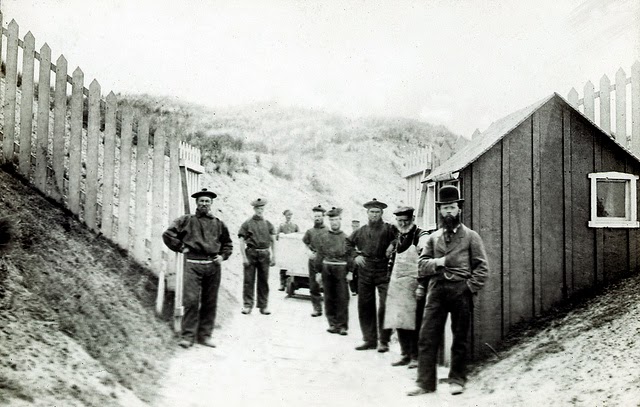
The loading gates at the Nobel Factory in Ardeer circa 1900.
The employees are all wearing Tam O’Shanters except of course for the foreman with his bowler hat. www.flickr.com/photos/nayesterdays/5567523975/ North Ayrshire Council photo collection/
The employees are all wearing Tam O’Shanters except of course for the foreman with his bowler hat. www.flickr.com/photos/nayesterdays/5567523975/ North Ayrshire Council photo collection/
Fascinating as I found his years at Nobel’s, the mystery was what he had been up to before that. How had Finlay had ended up in an obscure spot in Ayrshire, because his death certificate revealed he had been born in England. Several vital details were provided by this record. These in turn led to finding that long before his Stevenston phase he had been in the British Army.
Born in the parish of St George’s East, in the district known as Borough, London, in 1841 to William Gibson and Ann Morgan Jenkins, Finlay was a parasol maker by trade. He had at least two siblings, Margaret and William jnr.
How long Finlay practised his civilian occupation is not known, but the proceeds from parasol making were probably limited. For hundreds of young men in Victorian England, the army provided a reasonable alternative to poor living conditions in civvy street. William Gibson snr. was a soldier, and in due course both his sons would march in his footsteps, though neither very willingly - particularly the younger - judging from their army documents.
William jnr, joined, as Private No. 1265, the 2nd battalion of the 4th Regiment of Foot (the Buffs). He would turn out to be, so to speak, a loose cannon. More about William and his colourful career in due course.
 |
| Finlay Gibson's Army Discharge papers give his civilian occupation as parasol maker
To be continued
|
From service records it was possible to build up a fairly comprehensive picture of Finlay’s career. There were clues as to his later life when his army days were over.
These together with Census records offered a wealth of information as well as a welcome explanation of Finlay’s popping up so unexpectedly in a small Ayrshire town by 1881, as he entered his forties.
Sunday, October 12, 2014
Tracing a Military Man 1
My maternal great grandfather (that is, my mother’s mother’s father) was a
shadowy character from the word go. According to an aunt, in one of her more
lucid moments, he had been ‘a military man’.
Apart from that vague snippet, alI we knew was that his first name was Finlay, thus bequeathing to me, the self-appointed family historian, an annoying selection of variant spellings of the forename which cropped up not only in documents pertaining to the man himself but also applied to several descendants. Great grandfather, his parents, the Census enumerators and the British Army, seemed to prefer Finlay but he also answered to Finley andFindlay
Apart from that vague snippet, alI we knew was that his first name was Finlay, thus bequeathing to me, the self-appointed family historian, an annoying selection of variant spellings of the forename which cropped up not only in documents pertaining to the man himself but also applied to several descendants. Great grandfather, his parents, the Census enumerators and the British Army, seemed to prefer Finlay but he also answered to Finley and
 |
| Finlay Gibson (1841-1924) |
Neither forename nor surname marked him as being of obviously
Scottish descent, though it was in Ayrshire, Scotland, that he spent the
greater part of his life and he lies buried in that county, in the village of
Stevenston.
Stevenston’s primary claim to fame is that towards
the end of the 19th c Nobel’s Dynamite Factory was located there, cushioned
amongst the sand dunes on the isolated beach in the hope of minimizing or at
least containing the dangers of explosion inherent in producing such a volatile
material.
Despite precautions, however, explosions occurred
from time to time, causing maiming and fatalities among those inhabitants who
were employed at the ‘dinnamit’, as it was called in local parlance.
Many years later, when the dynamite factory was no
longer in existence, I visited the area and spoke to other great grandchildren
whose ancestors, male and female, had worked at the dinnamit, by which colloquial term it was then still known. They
seemed amazed and pleased that someone from as far distant as South Africa
 |
| Women workers at the dynamite factory. Photo: Ayrshire Libraries Forum |
At first uncertain what duties were covered by this occupation, it became clear to me that Finlay would be positioned at the factory
entrance to search everyone going in for any sign of matches or other
inflammable material carried on their person, and to make sure such items were
removed. It was a vital task carrying authority and responsibility. No doubt
Finlay had a vested interest in carrying out his duties well, since several
members of his family were among the factory’s workforce.
 |
| Workers being searched for matches before being admitted to the factory. Photo: Ayrshire Libraries Forum
To be continued.
|
Subscribe to:
Posts (Atom)