Showing posts with label Reynolds. Show all posts

Sunday, March 30, 2014

Passengers to Natal: Justina 1850


Justina arrived at Natal 11 November 1850, a barque commanded by Captain Brown 

Not one of Byrne's ships, the Justina carried the second party of immigrants under a copy-cat scheme privately arranged by George P Murdoch (who worked for Byrne's solicitors) and Capt. Richard W Pelly. Edmund Morewood was agent in Natal. The first group of settlers sent out by Murdoch had arrived earlier in the Ballangeich.

Passengers included the Reynolds family, later important Natal sugar planters, the Chadwicks, the Vinsons, the Griffiths family and the Buchanans.

In the original Natal Witness extract note mention of the Byrne vessels Emily, Devonian and Bernard.

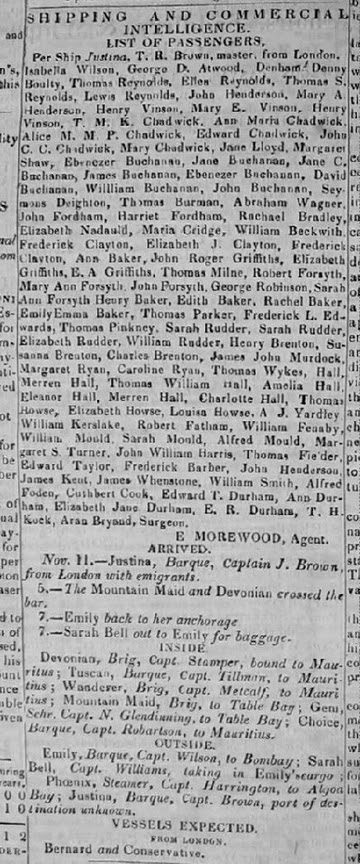
SHIPPING AND COMMERCIAL INTELLIGENCE

LIST OF PASSENGERS
Per Ship Justina, Brown, master, from London.

Isabella Wilson 
George D Atwood 
Denham Denny Boulty 
Thomas Reynolds 
Ellen Reynolds 
Thomas S Reynolds 
Lewis Reynolds 
John Henderson 
Mary A Henderson 
Henry Vinson 
Mary E Vinson 
Henry Vinson 
TMK Chadwick 
Ann Maria Chadwick 
Alice MMP Chadwick 
Edward Chadwick 
John CC Chadwick 
Mary Chadwick 
Jane Lloyd 
Margaret Shaw 
Ebenezer Buchanan 
Jane Buchanan 
Jane C Buchanan 
James Buchanan 
Ebenezer Buchanan 
David Buchanan 
William Buchanan 
John Buchanan 
Seymons Deighton 
Thomas Burman 
Abraham Wagner 
John Fordham 
Harriet Fordham 
Rachael Bradley 
Elizabeth Nadauld 
Maria Cridge 
William Beckwith 
Frederick Clayton 
Elizabeth J Clayton 
Frederick Clayton 
Ann Baker 
John Roger Griffiths 
Elizabeth Griffiths 
EA Griffiths 
Thomas Milne 
Robert Forsyth 
Mary Ann Forsyth 
John Forsyth 
George Robinson 
Sarah Ann Forsyth 
Henry Baker 
Edith Baker 
Rachel Baker 
Emily Emma Baker 
Thomas Parker 
Frederick L Edwards 
Thomas Pinkney 
Sarah Rudder 
Sarah Rudder 
Elizabeth Rudder 
William Rudder 
Henry Brenton 
Susanna Brenton 
Charles Brenton 
James John Murdock 
Margaret Ryan 
Caroline Ryan 
Thomas Wykes 
Hall 
Merren Hall 
Thomas William Hall 
Amelia Hall 
Eleanor Hall 
Merren Hall 
Charlotte Hall 
Thomas Howse 
Elizabeth Howse 
Louisa Howse 
AJ Yardley 
William Kerslake 
Robert Fatham (Tatham) 
William Fenaby 
William Mould 
Sarah Mould 
Alfred Mould 
Margaret S Turner 
John William Harris 
Thomas Fielder 
Edward Taylor 
Frederick Barber 
John Henderson 
James Kent 
James Whenstone 
William Smith 
Alfred Foden 
Cuthbert Cook 
Edward T Durham 
Ann Durham 
Elizabeth Jane Durham 
ER Durham 
TH Kock 
Aran Bryand, Surgeon. 
E MOREWOOD, Agent.

ARRIVED
Nov 11 - Justina, Barque, Captain J Brown from London with emigrants.
Nov 5 - The Mountain Maid and Devonian crossed the bar.
Nov 7 - Emily back to her anchorage.
Nov 7 - Sarah Bell out to Emily for baggage.

INSIDE
Devonian, Brig, Capt Stamper, bound to Mauritius;
Tuscan, Barque, Capt Tillman, to Mauritius;
Wanderer, Brig, Capt Metcalf, to Mauritius;
Mountain Maid, Brig, to Table Bay;
Gem, Schr. Capt W Glendining, to Table Bay;
Choice, Barque, Capt Robertson, to Mauritius.

OUTSIDE
Emily, Barque, Capt Wilson, to Bombay:
Sarah Bell, Capt Williams, taking in Emily's cargo;
Phoenix, Steamer, Capt Harrington, to Algoa Bay;
Justina, Barque, Capt Brown, port of destination unknown.

VESSELS EXPECTED
From London
Bernard and Conservative


Monday, April 15, 2013

Sugar and Natal: the Pioneers - Morewood


For decades prior to white settlement in Natal, there was an indigenous variety of sugar cane which grew wild and was known to the Zulus as imphe. It was chewable and sweet, but its sugar content wasn't found by settlers to be high enough to make its cultivation commercially viable. There was also umoba, an imported strain of true sugarcane: in 1837 the traveller Nathaniel Isaacs mentions both these plants. In 1858, Michael Jeffels, a planter and miller at Isipingo, stated that to his certain knowledge sugarcane was growing in the area of the Isipingo River at the time of Shaka's war with Faku in 1828.

EDMUND MOREWOOD

Morewood, regarded as the founding father of the sugar industry in Natal, made a very early visit to this area in 1833, before spending time in Australia, New Zealand and Mauritius. He returned to Natal in 1838, after the Battle of Blood River, when British military forces had been temporarily withdrawn and the flag of the Voortrekker Republic of Natalia had been hoisted at the port. Morewood was on good terms with the Voortrekkers and was one of the men chosen to visit the Zulu King, Mpande, in the hopes of making a peace treaty. In 1840 Morewood was appointed Harbour Master and Commissioner of Customs under the Republican government, and it was in this capacity that he became involved in the events of 1842 when the vessels Conch and Southampton brought reinforcements to assist in raising the siege of a British force at what is now the Old Fort, Durban. William Bell, Captain of the Conch, remarked that Morewood, on being rowed out to the schooner, accompanied by the Voortrekkers' Military Secretary, was astonished to find the Conch's lower deck bristling with grenadiers 'as thick as bees'. According to Bell's Narrative, Morewood 'had sufficient power of speech left to say he was a friend of the English, but at the same time I could see that he was much embarrassed by the position he had placed himself in ...' and it truly was a difficult situation for an Englishman in the employ of the Trekkers.

Morewood's farm, Compensation, in 1852
However, Morewood remained in Natal and though the British authorities retained some understandable suspicions as to his allegiance, he quickly adjusted to the new British regime and began to pursue his interest in sugar cultivation.

In November 1847 the first plant cane was brought to Natal from Mauritius on the Sarah Bell, by the Milner brothers. It's thought that this cane, or a portion of it, was imported for Morewood. He began planting towards the end of 1847 or early in 1848. At that time he was employed as manager of the Natal Cotton Company on the Umhloti River, but he resigned his position in July 1849 to focus on growing sugar on his property, Compensation.

According to John Robinson's Notes on Natal written in 1870:
... before 1850 agriculture in this colony was confined to the growth of a little wheat by the Boers, and of a fair quantity of maize by the natives. Cotton culture ... had been attempted at New Germany (by the Bergtheil Settlers) ... a few coffee bushes were bearing berries in the garden of a private householder of Durban, and a small patch of sugarcane was being planted by Mr Morewood at Compensation.' Arrowroot (to a value of £31) was the first agricultural product to be exported from Natal, in 1853, but the following year the export record showed a new export - Sugar, £2. 
It was a small beginning, but of great significance. After that date, sugar was exported every year in increasing quantities, and, as Morewood had predicted, it became the 'staple article of Natal'. 

A young man named George Lamond who arrived in Durban in June 1850 on the Byrne ship Unicorn, joined Morewood at Compensation and later wrote that he found the estate under the management of 'a surveyor named George Jackson, with some half-a-dozen ploughmen (plus native labour). We had six acres under cane ... When I left in 1854 we had more than 100 acres of cane ready for crushing. In 1851 I helped to make and eat the first sugar manufactured in Natal ... The ploughmen were Randal, South, Coward, Dykes and an apprentice named Moore, son of a Gloucester parson, and a grand old Dutch gardener named van Versfeld'. Late in 1850, Morewood constructed a simple mill, which would be used to crush his first cane crop.

Morewood, a man of apparently boundless energy, was also involved in immigration as agent in Natal for the Justina, which arrived in November 1850 under a private scheme arranged by George Murdoch and Capt Richard Pelly. Among the passengers were Thomas and Lewis Reynolds who would become leading figures in the sugar industry. The ship also brought £5 000 worth of merchandise for sale in South Africa: this venture had been arranged by Morewood's brother, J.J. Morewood, then residing in London.